AI Investments Are the War Bonds of the New Cold War
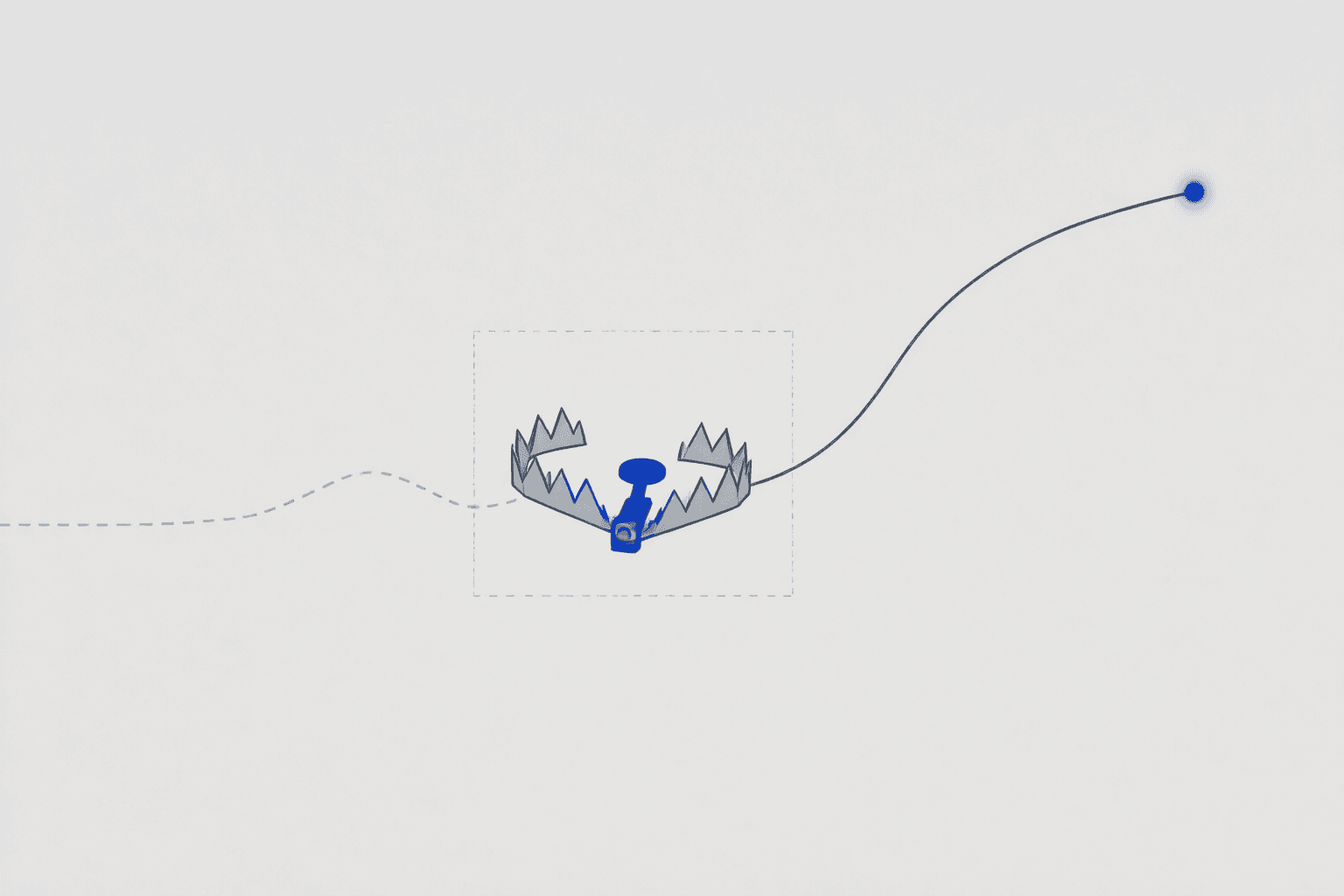
The AI buildout is not a bubble. It is a war bond market. $660 billion a year. Four CEOs who say they would rather go bankrupt than lose. War bonds pay off only in victory.

"I'm willing to go bankrupt rather than lose this race."
That is Larry Page, the co-founder of Google, as investor Gavin Baker reported in 2025. Sam Altman told a Stanford audience in May 2024 that he does not care whether OpenAI burns $500 million, $5 billion, or $50 billion a year — it is "totally worth it" to build AGI. Mark Zuckerberg said in September 2025 that the greater risk is "not being aggressive enough rather than being too aggressive," and that even losing a couple of hundred billion dollars would be preferable to falling behind in the race for superintelligence. Satya Nadella told an internal Microsoft town hall in mid-2025 that he was "haunted" by the story of Digital Equipment Corporation — a dominant tech company made obsolete by a strategic error — and that AI could do the same to Microsoft.
These are not rhetorical flourishes. This article argues that without the existential frame they articulate, the investment behavior of the industry does not make sense. The talk is real. What follows are its implications.
The bill for that conviction is now $660 billion a year and rising. The four largest US hyperscalers — Amazon, Microsoft, Google, and Meta — are on track to spend that amount in 2026, according to company guidance and analyst estimates compiled by Morgan Stanley. Goldman Sachs projects $1,018 billion in 2027. JPMorgan estimates the cumulative total will reach $5 trillion through 2030. In 2020, the same four companies spent $80 billion.
The investors funding this buildout — equity holders, debt holders, GPU-backed securitization buyers — are purchasing the war bonds of a new cold war. The asset class has the same structural features as the original: it is issued to finance a conflict that the issuers believe they cannot afford to lose, it pays a return only if the issuer survives to honor it, and its value depends less on the underlying cash flows than on the outcome of the war.
War Economies Do Not Stop at Breakeven
In a standard investment cycle, uneconomic demand eventually disappears. The start-ups funded by easy venture capital run out of money. The cycle turns.
The AI buildout does not follow this pattern. The entities spending are not fragile start-ups. They are the most profitable technology companies in history, deploying operating profits from monopolistic core businesses, plus a small number of well-capitalized private labs backed by investors who believe the prize is existential.
This changes the termination condition. A peacetime investment cycle stops when the marginal return turns negative. A war economy stops when one side is exhausted — when it can no longer fund the war, not when the war stops making financial sense.
The prisoners' dilemma formalizes the dynamic. For any single company, aggressive investment is the dominant strategy regardless of what competitors do. If competitors are building, you must build to have a chance. If competitors are not building, building lets you capture the entire market. The individually rational strategy is to spend whatever you can. The collectively rational outcome — invest less, earn adequate returns — is not a Nash equilibrium. Any single defector can capture the game by spending more.
The participants have deep pockets. Google's search business alone generated roughly $200 billion in revenue in 2024 at operating margins above 30 percent. Meta's social media empire is similarly fortified. Microsoft's enterprise SaaS and cloud businesses throw off tens of billions in annual free cash flow. OpenAI and Anthropic have raised capital at valuations implying investors believe the winner will be worth trillions.
The spending is not constrained by current AI unit economics. It is constrained by the capacity of the core businesses and capital markets to keep funding it. That produces a war of attrition: the spending escalates until someone cannot keep up.
The Demand the Whole Structure Rests On
The majority of the escalating investment described above goes into building out data centers. Launching a data center today is profitable — as long as the GPU capacity inside it can be rented at rates that cover the cost of capital. Those rates hold only if demand continues to outstrip supply. And demand is not organic.
The marginal buyer of GPU compute is not the enterprise deploying a chatbot. It is not the hospital running diagnostic models. It is a small group of large model makers — OpenAI, Anthropic, Google DeepMind, Meta AI, Microsoft Copilot, xAI — that constitute the bulk of demand for the compute filling the new data centers.
Every one of them is cash-flow negative on AI.
OpenAI spent roughly 50 percent of its 2024 revenue on inference costs alone — the compute required to run its models for paying customers. Training costs consumed another 75 percent. The combined 125 percent of revenue meant the company lost money on every query. For 2025, with revenue reaching $20 billion on an annualized basis, inference costs rose to $8.4 billion and gross margin fell to 33 percent — down from 40 percent in 2024. Internal documents project a $14 billion loss in 2026. Free cash flow is not expected to turn positive until 2029.
Anthropic's trajectory is improving but not yet sustainable. Gross margin improved from negative 94 percent in 2024 to roughly 40 percent in 2025. Revenue exploded from $4.6 billion to a run rate above $30 billion by early 2026. The company posted an operating profit in Q2 2026. But it has raised over $18 billion in cumulative funding and burned a cumulative $15 billion since 2021. Its internal plan does not target positive cash flow until 2028.
The hyperscalers' AI divisions are not separately reported, but the aggregate numbers tell the story. Google and Meta together generated over $150 billion in operating income from their core advertising businesses in 2025. Both are now guiding to CapEx levels that absorb the entirety of that operating cash flow. Amazon's 2026 free cash flow is forecast at negative $17 billion to negative $28 billion by sell-side consensus. The core businesses are profitable. AI is not. The subsidy flows from one to the other.
This is the structure that matters. The GPU rental rates that underpin data center financing, the utilization assumptions embedded in depreciation schedules, the $150 billion in projected GPU-backed securitizations — all rest on demand from entities that lose money on every unit of compute they consume. The demand is real, in the sense that hundreds of billions of dollars are being spent. It is not self-sustaining, in the sense that it is not funded by customers, but by investors.
The Escalation Has Not Peaked
The consensus among analysts is that AI CapEx will peak in 2028. Barclays models the inflection based on recursive self-improvement — the point at which AI systems become capable enough to reduce the cost of developing better AI systems. Training operational expenditure peaks in 2029, so capital expenditure peaks roughly a year earlier. Between now and the peak, the spending continues to accelerate: Goldman Sachs estimates $1,018 billion for US hyperscalers in 2027, before any plateau.
This trajectory matters because of the sequence it implies. If CapEx peaks in 2028, the marginal dollar deployed in 2027 and 2028 is the most expensive dollar with the shortest earning window — the assets deployed last have the least time to generate revenue before the investment cycle turns. The last money in is the worst money. In peacetime, a rational investor slows spending before the peak to avoid deploying capital that will not earn back its cost. In wartime, you spend the last dollar because losing is worse than wasting it.
The timing risk is acute. If recursive self-improvement arrives on schedule, the final dollars buy the capability that retroactively makes all prior spending more efficient. If it does not — if the technology plateaus instead of compounding — the industry has spent at maximum intensity at exactly the moment before the returns diminish. Exhaustion arrives at peak spend.
Even the Builders Disagree on Asset Life
One parameter determines how fast the war chest must grow to maintain the same capability: the obsolescence rate of AI hardware.
NVIDIA's B200 delivers roughly four times the floating-point performance of the H100 it replaces. The B300, expected in the next cycle, delivers 11 to 15 times the throughput per GPU on large language model inference. NVIDIA's architectural cadence runs roughly 18 to 24 months. A GPU cluster that is state-of-the-art today is economically second-tier within two generations.
Algorithm efficiency compounds the effect. The inference cost for a fixed quality bar has fallen by approximately 400 times in three years. The same dollar of compute produces far more intelligence than it did when the current CapEx cycle began.
And yet the four companies spending the $660 billion cannot agree on how long the hardware lasts. Amazon shortened its server and networking equipment useful life from six years to five in early 2025, citing "the increased pace of technology development, particularly in artificial intelligence and machine learning." Meta extended to 5.5 years, reducing 2025 depreciation by $2.9 billion. Microsoft extended from four years to six. Google sits at roughly six.
Two are betting obsolescence is accelerating. Two are betting it is decelerating. They cannot all be right. The answer determines how fast the subsidy must grow. If Amazon is correct, each dollar of CapEx buys less durable capability, and the war chest depletes faster for the same position on the frontier.
Who Holds the Bonds
The war bond structure produces different outcomes for different holders.
The issuing generals — the CEOs — face the dilemma directly. Building aggressively is the only strategy that preserves the option to win. Losing the platform war while preserving capital is a loss from which there is no recovery. Overbuilding alongside every peer is survivable: the entire sector writes down assets together, and no board can single out a CEO for making the same bet as every competitor.
The venture investor in an AI lab holds the bonds of a single belligerent. If their lab achieves model dominance and captures a material share of a trillion-dollar market, the return justifies the subsidy. If the models commoditize or another lab wins, the investment is zero. The position is a binary bet, rationally sized for a portfolio that contains many such bets. The war is the premise, not the problem.
The index-fund investor holds the bonds of every belligerent. The distribution of who wins does not matter. What matters is the aggregate: does the total value created for public companies exceed the cumulative CapEx? If AI becomes a $1 trillion annual revenue market by 2030 and public companies capture 70 percent of it, the payback on total CapEx is roughly four years at steady state. If AI is a $300 billion market, the payback stretches past 15 years. The index fund absorbs the collective outcome. It wins if the war produces a victor valuable enough to justify the total cost of fighting. It loses if the costs exceed the spoils.
The debt holder has the most acute exposure and the least upside. GPU-backed securitizations, projected at $150 billion, price the underlying collateral as if the obsolescence risk is negligible. CoreWeave, the largest neo-cloud, carries $14.2 billion in debt secured by GPU assets. Its revenue depends heavily on contracts with the same hyperscalers that are building competing infrastructure. Microsoft accounted for 67 percent of CoreWeave's 2025 revenue. Every data center Microsoft builds reduces its need for CoreWeave's capacity. The contracts are multi-year. The renewal probability drops as in-house capacity grows. The debt is priced for renewal. The war makes renewal uncertain.
The corporate user of AI benefits regardless. Cheaper compute, more capable models, and redundant supply are all downstream of excess CapEx. The companies paying OpenAI and Anthropic for API access are, in effect, partially funded by the venture capital that keeps those labs operating below cost. The war is a gift to its bystanders.
How the War Ends
How the war ends depends on two questions that the current spending cannot answer. The first is the nature of the technology: what is the limit of the value additional intelligence can create, and what is the limit of the marginal cost of providing it? The second is the structure of the market: does demand for intelligence follow a winner-take-most dynamic, or does the market support a stable oligopoly?
These questions determine the size of the prize and who captures it. They are addressed in a companion paper, "The Limits of Intelligence." For the war bond holder, what matters is that the answers are not knowable in advance — and the $660 billion is being deployed as if the most favorable outcome is not merely possible but the base case.
This is the first of a series on the economics of AI infrastructure investment. Companion papers address the peacetime Kelly criterion ("What AI Investment Would Look Like in Peacetime"), the retail investor's aggregation problem ("Why the Retail Investor Cannot Solve the Prisoners' Dilemma"), and the structure of the prize ("The Limits of Intelligence").