AI Is a $660B Prisoners' Dilemma. Your Index Fund Owns Every Prisoner.
The demand driving the largest infrastructure buildout in corporate history is not organic. It is a subsidy — funded by venture capital and the operating profits of businesses that existed before AI arrived. The subsidy is durable because the stakes are existential. That changes how long the overinvestment can last, and who pays when it stops.
The four largest US hyperscalers — Amazon, Microsoft, Google, and Meta — poured roughly $300 billion into capital expenditure in 2025. In 2026, the combined figure is on track to reach $660 billion, according to company guidance and analyst estimates compiled by Morgan Stanley. In 2020, the same four companies spent $80 billion. CapEx now consumes approximately 100 percent of their combined operating cash flow, against a 10-year average of 40 percent.
The last time a group of companies spent this much, this fast, on infrastructure with unproven returns, it was the telecom industry laying fiber between 1996 and 2001. That ended with more than $2 trillion in stock market value destroyed — and also with the fiber infrastructure on which the next two decades of internet innovation were built.
The telecom analogy captures the scale. It misses the structure. The fiber overbuild was driven by demand expectations that collapsed when the dot-com bubble burst. The AI buildout is driven by a demand base that is not organic end-user spending at all. It is an investor subsidy — and that makes it simultaneously more fragile and more durable than the last cycle.
Who Is Buying All These GPUs?
The marginal buyer of GPU compute is not the enterprise customer deploying a chatbot on its website. It is not the hospital running diagnostic models. It is not the startup building a vertical AI application. Each of these exists, but none sets the price.
The marginal buyer is a small group of large model makers. OpenAI. Anthropic. Google DeepMind. Meta's AI division. Microsoft's Copilot operation. xAI. Together, they constitute the bulk of demand for the compute that fills the data centers the hyperscalers are building.
Every one of them is cash-flow negative on AI.
OpenAI spent roughly 50 percent of its 2024 revenue on inference costs alone — the compute required to run its models for paying customers. Training costs consumed another 75 percent. The combined 125 percent of revenue meant the company lost money on every query, every subscription, every API call. For 2025, with revenue reaching $20 billion on an annualized basis, inference costs rose to $8.4 billion and the gross margin fell to 33 percent — down from 40 percent in 2024, despite the revenue growth. Internal documents project a $14 billion loss for 2026. Free cash flow is not expected to turn positive until 2029.
Anthropic's unit economics are better but not yet sustainable. Gross margin improved from negative 94 percent in 2024 to roughly 40 percent in 2025, and compute cost per revenue dollar fell from $0.71 to a projected $0.56 through mid-2026. Revenue exploded from $4.6 billion in 2025 to a run rate above $30 billion by early 2026. Training costs are roughly one-quarter of OpenAI's. The company posted an operating profit in Q2 2026. But it has raised over $18 billion in cumulative funding and lost a cumulative $15 billion since 2021. Its internal plan does not target positive cash flow until 2028.
The hyperscalers' AI divisions are harder to isolate because they are not separately reported. But the aggregate numbers are telling. Google and Meta together generated over $150 billion in operating income from their core advertising businesses in 2025. Both are now guiding to CapEx levels that absorb the entirety of that operating cash flow and more. Amazon's 2026 free cash flow is forecast at negative $17 billion to negative $28 billion by sell-side consensus. The core businesses are profitable. AI is not. The subsidy flows from one to the other.
This is the structure that matters. The GPU rental rates that underpin data center financing, the utilization assumptions embedded in depreciation schedules, the $150 billion in GPU-backed securitizations — all of it rests on demand from entities that lose money on every unit of compute they consume. The demand is real, in the sense that billions of dollars are being spent. It is not self-sustaining, in the sense that the spending is funded by investors, not customers.
Why This Makes Overinvestment Durable
In a standard market, demand that is uneconomic eventually disappears. The start-ups funded by easy venture capital during a bubble run out of money. Their customers — who were other start-ups funded by the same venture capital — disappear too. The cycle turns.
The AI buildout does not follow this pattern, because the entities doing the spending are not start-ups burning through a fixed round of funding. They are the largest and most profitable technology companies in history, deploying operating profits from monopolistic core businesses, plus a small number of well-capitalized private labs backed by investors who believe the prize is existential.
This changes the termination condition. In a normal overinvestment cycle, spending stops when the marginal return turns negative. In an existential arms race, spending stops when the participants are exhausted — when one side can no longer fund the war, not when the war stops making financial sense.
The prisoners' dilemma formalizes this. For any single company, aggressive investment is the dominant strategy regardless of what competitors do. If competitors are building, you must build to have a chance. If competitors are not building, building lets you capture the entire market. The individually rational strategy is to spend whatever you can.
But when all four hyperscalers and the major AI labs play the dominant strategy, total CapEx reaches a level that cannot be justified by current AI revenue. The collectively rational outcome — invest less, earn adequate returns, preserve capital — is not a Nash equilibrium. Any single defector can capture the whole game by spending more.
The difference between this prisoners' dilemma and the standard version is that the prisoners have very deep pockets. Google's search business alone generated $200 billion in revenue in 2024 at operating margins above 30 percent. Meta's social media empire is similarly fortified. Microsoft's enterprise SaaS and cloud businesses throw off tens of billions in annual free cash flow. OpenAI and Anthropic have demonstrated an ability to raise capital at valuations that imply investors believe the winner will be worth trillions.
The spending is not constrained by current AI unit economics. It is constrained by the capacity of the core businesses and capital markets to keep funding it. That is a much higher ceiling.
The Depreciation Question That Still Matters
Even under the war logic, one parameter determines how fast the subsidy must grow to maintain the same capability: the obsolescence rate of the hardware, δ.
NVIDIA's B200 delivers roughly four times the floating-point performance of the H100 it replaces. The B300, expected in the next cycle, delivers 11 to 15 times the throughput per GPU on large language model inference. NVIDIA's architectural cadence runs roughly 18 to 24 months. A GPU cluster that is state-of-the-art today is economically second-tier within two generations.
Algorithm efficiency compresses the requirement further. The inference cost for a fixed quality bar has fallen by approximately 400 times in three years. The same dollar of compute produces far more intelligence than it did when the current CapEx cycle began.
And yet the four companies spending the $660 billion cannot agree on how long the hardware lasts.
Amazon shortened its server and networking equipment useful life from six years to five in early 2025, citing "the increased pace of technology development, particularly in artificial intelligence and machine learning." It took a separate $0.6 billion charge for early asset retirements. Meta extended its useful life to 5.5 years, reducing 2025 depreciation by $2.9 billion. Microsoft extended from four years to six. Google sits at roughly six.
Two are betting obsolescence is accelerating. Two are betting it is decelerating. They cannot all be right. And the answer determines whether the war can be sustained: if δ is high, each dollar of CapEx buys less durable capability, and the subsidy must grow faster just to maintain position.
The Stakeholder Map
The subsidy structure produces different outcomes for different constituents.
The company executive faces the dilemma directly. Building aggressively is correct regardless of the aggregate outcome. Losing the platform war while preserving capital is a loss from which there is no recovery. Overbuilding alongside every peer is survivable — the entire sector writes down assets together, and no board can single out a CEO for making the same bet as every competitor. The incentives point one way.
The venture investor in an AI lab is placing a binary bet. If their lab achieves model dominance and captures a material share of a trillion-dollar market, the return justifies the subsidy. If the models commoditize or another lab wins, the investment is zero. The position is high-risk, high-reward, and rationally sized for a portfolio that contains many such bets. The prisoners' dilemma is the premise, not the problem.
The index-fund investor owns all four hyperscalers and, increasingly, the AI labs as they go public. The distribution of who wins does not matter. What matters is the aggregate: does the total value created for public companies exceed the $2.9 trillion in total CapEx projected between 2025 and 2028? If AI becomes a $1 trillion annual revenue market and public companies capture 70 percent of it, the payback on total CapEx is roughly four years at steady state. If AI is a $300 billion market, the payback stretches past 15 years. The index fund absorbs the collective outcome, good or bad.
The corporate user of AI benefits from the subsidy regardless. Cheaper compute, more capable models, and redundant supply are all downstream of excess CapEx. The companies that are paying OpenAI and Anthropic for API access are, in effect, being partially funded by the venture capital that keeps those labs operating below cost. The subsidy flows from investors to AI labs to enterprise customers, who pay less for capability than it costs to produce.
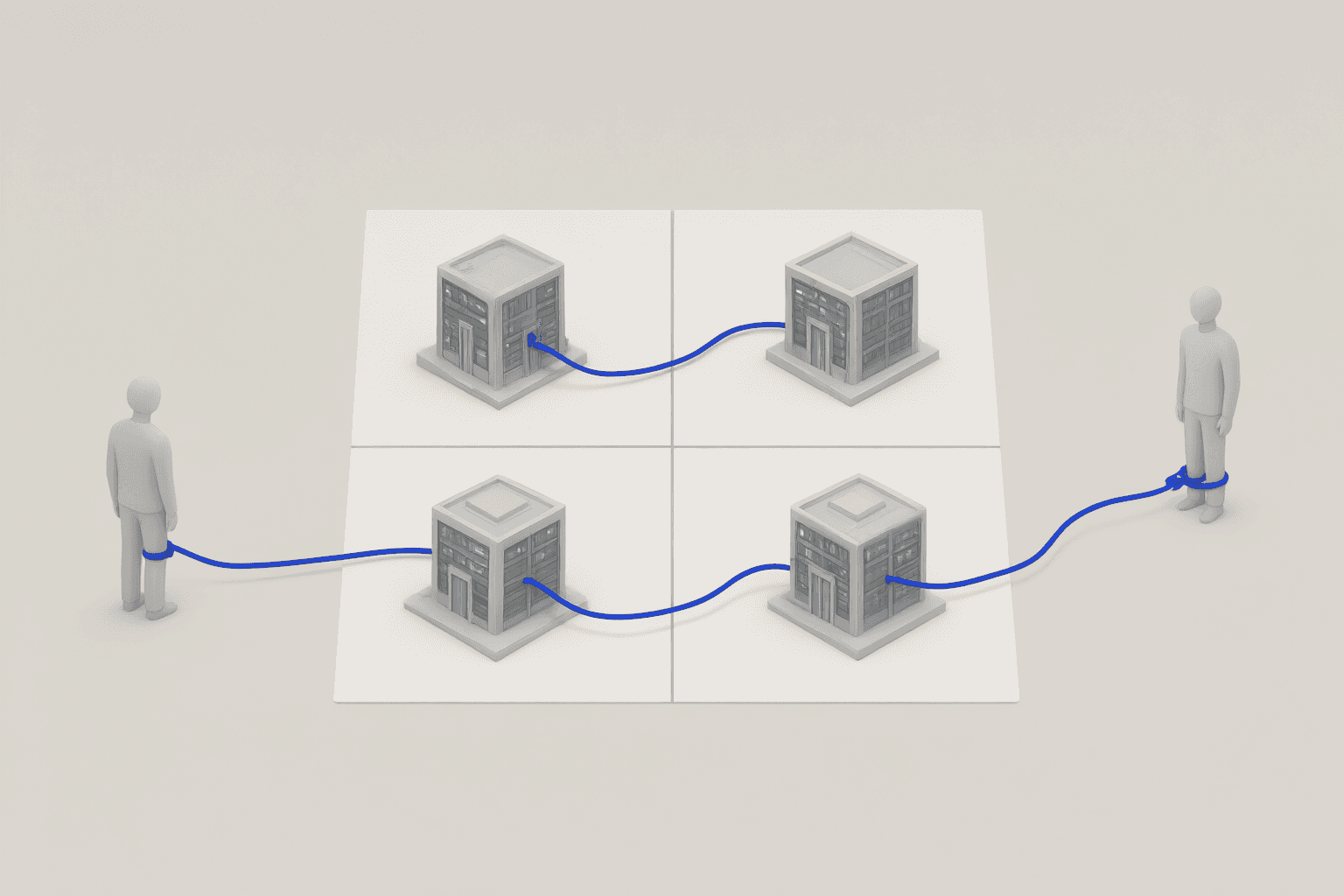
The debt holder has the most acute exposure. GPU-backed securitizations, projected at $150 billion, price the underlying collateral as if the obsolescence risk is negligible. CoreWeave, the largest neo-cloud, carries $14.2 billion in debt secured by GPU assets. Its revenue depends heavily on contracts with the same hyperscalers that are building competing infrastructure. Microsoft accounted for 67 percent of CoreWeave's 2025 revenue. Every data center Microsoft builds reduces its need for CoreWeave's capacity. The contracts are multi-year, but the renewal probability drops as in-house capacity grows. The debt is priced for renewal. The subsidy structure makes renewal uncertain.
What Ends the War
The war ends when a participant runs out of ammunition. The most likely trigger is not a collective realization that the returns are inadequate. It is a specific exhaustion event.
One candidate: the capital markets close to the AI labs. OpenAI has raised approximately $20 billion in cumulative funding and is burning $14 billion to $17 billion annually. Anthropic has raised $18 billion and is burning less but still drawing on external capital. If the IPO window closes or private investors reassess the probability of a winner-take-most outcome, the labs' ability to fund compute consumption at current levels collapses. Their demand for GPUs contracts. The spot price falls. The contracted price follows. The collateral values underlying the GPU ABS decline. The financing structure unwinds from the bottom.
Another candidate: the core businesses that fund the hyperscalers' AI spending come under pressure. Google and Meta depend on digital advertising revenue that is sensitive to the macroeconomic cycle. Microsoft and Amazon depend on enterprise IT budgets that are not immune to recession. If the core business cash flows that subsidize the AI buildout compress, the investment capacity compresses with them. The war continues, but at a slower pace, and the companies that cannot sustain the pace lose ground.
The most durable candidate, paradoxically, is that the war continues until the technology itself resolves the dilemma. If inference costs continue to fall — and if the labs approach breakeven on unit economics before their capital runs out — the subsidy is no longer required. The demand becomes organic. The spending becomes self-sustaining. The prisoners' dilemma dissolves because the race produces positive returns for the survivors.
Anthropic's trajectory toward operating profitability in 2026 suggests this path is plausible. OpenAI's continued losses at much larger scale suggest it is not guaranteed.
For the index-fund investor, the question is whether the war ends with victory, exhaustion, or a negotiated peace that leaves all parties standing. Until the exhaustion point is visible, the index fund owns a bet that the prisoners' dilemma produces a tolerable aggregate outcome — and that the subsidy that funds it does not stop before the technology learns to pay for itself.