What AI Investment Would Look Like in Peacetime
If AI were a normal capital allocation problem, the Kelly criterion would tell you to invest a fraction of what the hyperscalers are spending. The gap between the two is the war premium. China, constrained by chip sanctions, is not an exception to the war frame — it is the war frame with a smaller arsenal.
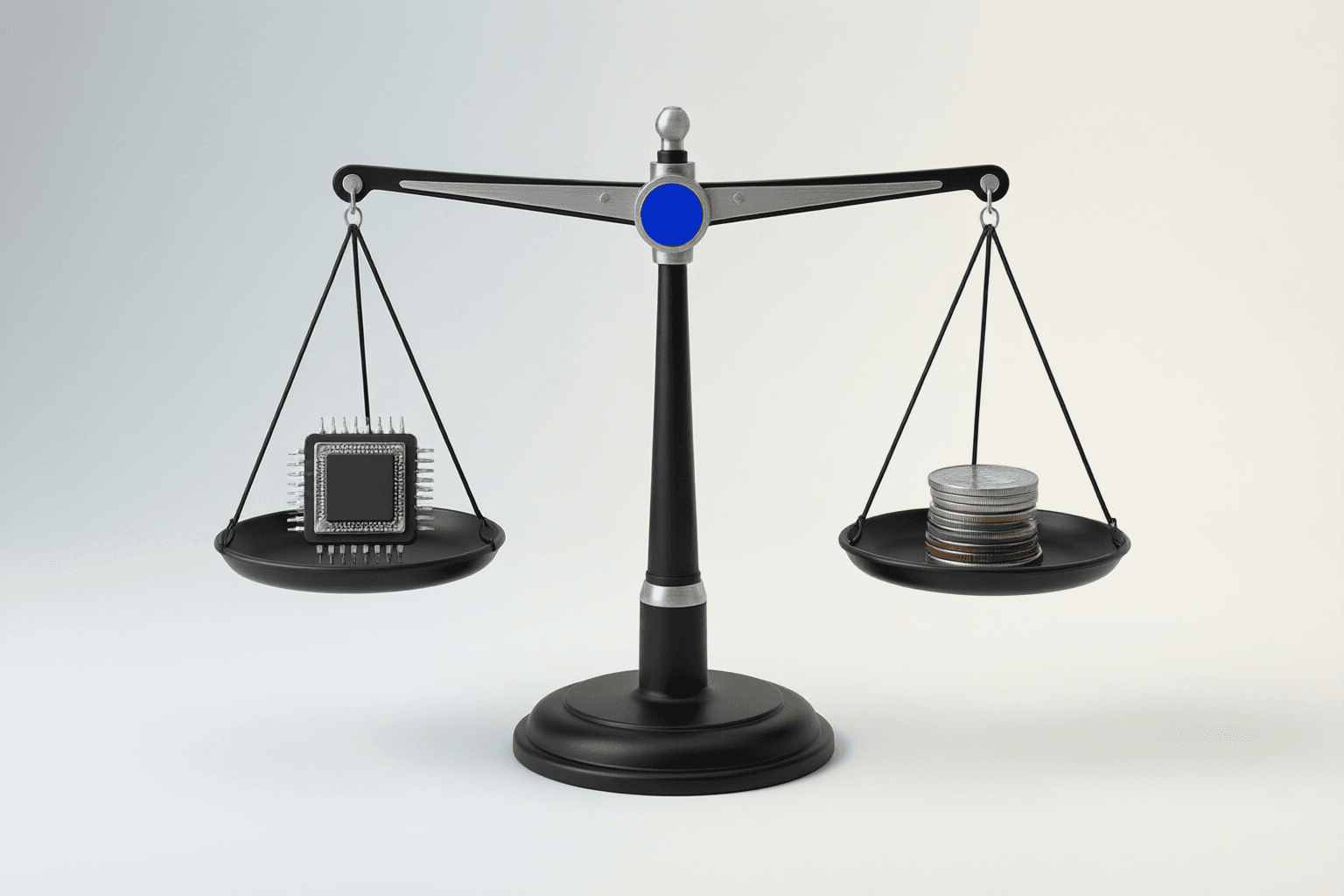
A peacetime investor facing the AI opportunity would ask three questions. What is the expected return on a dollar of GPU infrastructure? How wide is the range of possible outcomes? How much capital should I commit given the uncertainty? The Kelly criterion, the standard framework for optimal bet sizing under uncertainty, gives an answer. The observed behavior of the hyperscalers gives a different one. The gap between them measures the cost of treating an investment decision as an existential conflict.
The Three Parameters
The return on a dollar of AI infrastructure is determined by three numbers.
R₀, the initial yield. A $4.5 million cluster of 100 H100 GPUs, rented at current on-demand rates of roughly $3.50 per GPU-hour at 75 percent utilization, generates approximately $2.3 million in annual gross rental income — a 51 percent gross yield. At the low end of the market, with reserved long-tail pricing at $1.80 per GPU-hour, the yield falls to 27 percent. R₀ is plausibly in the range of 25 to 60 percent, with the forward direction dependent on whether supply growth or demand growth dominates. H100 rental rates have already fallen 60 to 76 percent from early 2025 peaks.
δ, the obsolescence rate. This is the annual rate at which a GPU cluster loses economic competitiveness against newer hardware. NVIDIA's architectural cadence of 18 to 24 months delivers 2 to 4 times the performance per watt per generation. Algorithm efficiency improvements — quantization, distillation, Mixture of Experts — compound the effect, reducing the compute required for a given quality bar by roughly 10 times per year. A conservative estimate puts δ at 25 to 40 percent annually: a GPU cluster retains 60 to 75 percent of its economic value after one year, 36 to 56 percent after two. Amazon's decision to shorten server useful life from six to five years implies δ of roughly 20 percent. Meta's extension to 5.5 years implies δ closer to 18 percent. The hardware's actual economic depreciation may be faster than either accounting estimate.
r, the cost of capital. The hyperscalers' weighted average cost of capital is approximately 9 to 11 percent, reflecting their investment-grade credit ratings and equity betas modestly above the market.
The Peacetime NPV
In peacetime, an investment is rational if the present value of expected cash flows exceeds the capital deployed. For an asset with initial yield R₀, depreciating at rate δ, discounted at r, the perpetuity approximation gives:
NPV factor = R₀ / (r + δ)
If the factor exceeds 1.0, the investment earns its cost of capital.
Under conservative assumptions — R₀ at 27 percent, δ at 40 percent, r at 10 percent — the factor is 0.54. The investment destroys nearly half its value. Under mid-range assumptions — R₀ at 40 percent, δ at 30 percent, r at 10 percent — the factor is 1.0. The investment breaks even. Under optimistic assumptions — R₀ at 60 percent, δ at 20 percent, r at 10 percent — the factor is 2.0. The investment doubles its capital.
The range is enormous. And that is before accounting for η, the demand elasticity that determines whether a 10-times fall in inference cost produces more or less total spending on compute. If η is less than 1, the addressable market shrinks as costs fall, and even the optimistic NPV case collapses.
What Kelly Would Say
The Kelly criterion addresses a different question: not whether an investment is positive-NPV, but how much to bet given that the parameters are uncertain. For a continuous investment with expected excess return μ and variance σ², the optimal fraction of capital is approximately:
f ≈ (μ − r) / σ²*
If the expected return premium over the cost of capital is 5 percentage points and the annual volatility of returns is 30 percent, f* is approximately 0.05 / 0.09, or 56 percent. That is the upper bound. It assumes the parameters are known.
Under ambiguity — when the investor cannot distinguish between the conservative, mid-range, and optimistic cases — the rational response is to size the bet using the conservative end of the confidence interval. If μ − r is 2 percent and σ² is 40 percent, f* falls to 0.02 / 0.16, or 12.5 percent.
A peacetime Kelly bettor facing the AI investment opportunity, with the parameter ranges available today, would allocate perhaps 10 to 30 percent of operating cash flow to AI infrastructure. The actual allocation is approximately 100 percent. The gap — 70 to 90 percentage points of operating cash flow — is the war premium.
The China Test
If the war frame is correct, it should apply wherever the stakes are perceived as existential. China offers a test.
Chinese hyperscalers — Alibaba, Tencent, ByteDance, and Baidu — are spending an estimated $102 billion on AI CapEx in 2026, against $764 billion for their US counterparts. The absolute gap is 7.5 to 1. But China's economy is smaller, and its technology companies are less profitable than the American hyperscalers. The relevant metric is not absolute spending but the share of available resources being committed.
Tencent's free cash flow turned negative in Q2 2026. Alibaba has pledged RMB 380 billion — roughly $52 billion — over three years. The Chinese government is funneling $50 to $70 billion annually into domestic AI chip production through its Big Fund III. The pattern is the same: operating cash flow being fully absorbed by AI CapEx, core business profits subsidizing model development, and state capital filling the gap.
China cannot buy NVIDIA's most advanced GPUs. Its domestic chips run at 7-nanometer on 70 to 80 percent yields against TSMC's 90-plus percent. The constraint is not prudence. It is the US export control. China's lower absolute spending is a function of a binding external constraint on capability, not a different investment philosophy. If the sanctions were lifted, the evidence suggests Chinese hyperscalers would increase spending to US levels — and the Communist Party's stated ambition to lead in AI by 2030 provides the same existential framing that drives the American buildout.
China is not the peacetime counterexample. It is the war frame operating under a supply constraint. The same logic, a smaller arsenal.
The War Premium
The peacetime investor, applying standard financial logic to the parameters observable today, would bet a fraction of available capital on AI infrastructure. The fraction depends on the assumptions. None of the plausible ranges produce 100 percent.
The hyperscalers are not applying peacetime logic. They are applying the logic of an arms race in which the cost of losing exceeds the cost of wasting capital. The gap between what Kelly would allocate and what they are spending is the war premium — the price of treating a technology investment as an existential conflict.
The premium will have been worth it if the war produces a victor valuable enough to compensate for the excess spending. It will look like a catastrophic misallocation if the technology commoditizes before any participant achieves a sustainable advantage. There is no way to know which outcome the premium is buying. That is the nature of war bonds.
This is the second of three articles on the economics of AI infrastructure investment. The first, "AI Investments Are the War Bonds of the New Cold War," examines the structure of subsidized demand and the war-of-attrition logic. The third, "Why the Retail Investor Cannot Solve the Prisoners' Dilemma," examines the aggregation paradox and the conditions under which diversified AI investment is rational for the individual investor.